
Why Automotive Assembly Lines Struggle with Precision and Speed
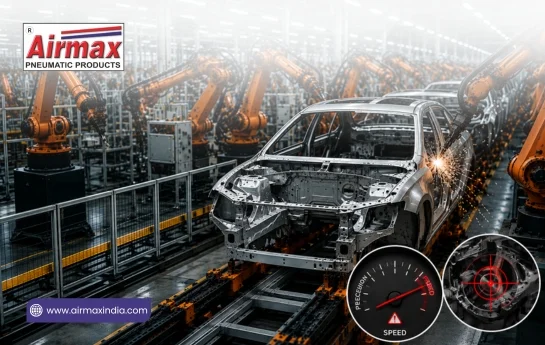
Automotive assembly lines run on a brutal combination of requirements: sub-millimetre precision, high-speed repetition, and near-zero tolerance for downtime — often across three shifts a day, every day of the year. When precision or speed starts slipping, it’s rarely the robots or the conveyor system that’s at fault. More often, it’s the pneumatic actuation layer beneath the automation — the cylinders, valves, and air-preparation components that physically move parts, clamp panels, and drive tooling.
Airmax Pneumatics Ltd has supplied pneumatic components to automotive and auto-ancillary manufacturers for over three decades. Here’s where precision and speed typically break down on assembly lines, and what actually fixes it.
1. Cylinder Response Lag Under High-Speed Cycling
Automotive lines often demand actuation cycles measured in fractions of a second — clamping a weld fixture, positioning a part, or driving a press tool. Standard cylinders not rated for high-frequency cycling develop response lag as internal seals wear, which shows up on the line as micro-delays that throw off takt time across the whole station.
The fix: Use cylinders specifically rated for continuous high-speed duty cycles rather than general-purpose models. Airmax’s pneumatic cylinder range is built for the repeatability automotive tooling demands.
2. Valve Switching Speed Bottlenecking Takt Time
Every automated clamp, ejector, or transfer mechanism is only as fast as the directional control valve driving it. On lines designed around tight takt times, even a valve that’s a fraction of a second slower than spec accumulates into a measurable throughput loss across a full shift.
The fix: Select valves matched precisely to the required switching speed and flow rate for each station — not a one-size-fits-all valve across the line. Airmax’s directional control valves, including fast-response solenoid series, are engineered for exactly this kind of high-tempo actuation.
3. Inconsistent Air Pressure Causing Positioning Drift
Precision positioning — for spot welding, panel alignment, or torque-critical fastening — depends on absolutely consistent air pressure at the point of use. Pressure drops caused by poor air preparation or fluctuating supply cause micro-variations in force, which shows up downstream as dimensional inconsistency or failed quality checks.
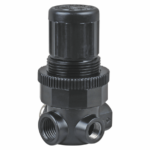
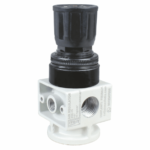
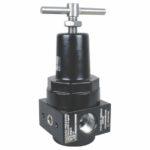
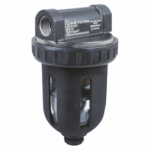
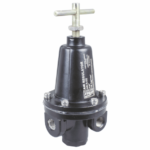
The fix: Stabilise pressure and remove contamination right at the actuator with properly specified FRL units. In plants with humidity or seasonal moisture issues, pairing this with moisture separators prevents drift caused by water ingress into the air line.
4. Rotary Automation Losing Precision Over Time
Many automotive stations use rotary indexing tables, turret tooling, or rotating weld fixtures — all of which rely on rotary joints to deliver air to moving parts. A worn or poorly designed rotary joint introduces play and inconsistent air delivery, which directly degrades positioning accuracy over thousands of cycles.
The fix: Specify precision-engineered rotary joints designed for continuous, high-cycle rotary automation rather than generic rotary unions.
5. Weak Links in Fittings and Tubing Causing Micro-Leaks
On lines running at full speed, even a minor leak at a fitting joint reduces effective pressure at the actuator just enough to affect clamp force or positioning accuracy — often too small a change to notice until quality data starts trending the wrong way.
The fix: Standardise on certified, leak-tested pneumatic accessories and fittings across all stations, and inspect them on the same cycle as major components.
Precision & Speed Failure Points at a Glance
| Failure Point | Effect on Line | Root Cause | Airmax Solution |
|---|---|---|---|
| Cylinder response lag | Takt time drift | Non-rated cylinders under high-speed cycling | High-speed Pneumatic Cylinders |
| Slow valve switching | Throughput loss | Generic valves used across all stations | Fast-response Directional Control Valves |
| Pressure inconsistency | Positioning drift, quality fails | Poor air preparation | FRL Units & Moisture Separators |
| Worn rotary joints | Accuracy degrades over time | Generic rotary unions | Precision Rotary Joints |
| Fitting micro-leaks | Reduced clamp/actuation force | Low-grade fittings | Certified Pneumatic Accessories |
Precision and Speed Are a System Design Problem, Not Just a Machine Spec
It’s tempting to treat precision and speed issues as a robotics or PLC programming problem, but in most plants we’ve worked with, the physical actuation layer sets the real ceiling on what the automation can achieve. A perfectly programmed robot arm still can’t outperform the cylinder and valve combination driving its end-of-arm tooling. Getting assembly lines to hit both precision and speed targets consistently comes down to matching every pneumatic component — cylinder, valve, air prep, rotary joint, fitting — to the actual cycle rate and tolerance the station demands, rather than defaulting to standard industrial-grade parts across the board.
Upgrade Your Line’s Pneumatic Foundation
Airmax Pneumatics Ltd has manufactured ISO- and CE-certified pneumatic cylinders, directional control valves, rotary joints, and FRL units since 1992, serving automotive and auto-ancillary manufacturers who need consistent precision at high speed.
Get a Quote or explore our complete product range to identify where your line is losing precision and speed.
Frequently Asked Questions
Why does an assembly line slow down even when the robots and PLCs are working correctly?
The bottleneck can often be in the pneumatic actuation layer rather than the control system. Pneumatic cylinders or directional control valves that cannot maintain the required cycle speed may slow down machine operations even when the robots and PLCs are functioning correctly. Properly selected, cycle-rated pneumatic components can help maintain consistent production speeds.
How does air pressure consistency affect precision on an assembly line?
Fluctuating compressed air pressure changes the force generated by pneumatic actuators. This variation can affect dimensional accuracy and repeatability in operations such as welding, clamping, pressing, and fastening where consistent actuator force is required. Proper air preparation and pressure regulation help improve pneumatic system stability.
Do rotary joints really affect precision on automotive lines?
Yes. Worn or damaged rotary joints can introduce mechanical play into rotating tooling, indexing tables, and other rotating equipment. Over high-cycle production runs, this additional movement can contribute to positioning inaccuracies and inconsistent machine performance. Regular inspection and timely replacement can help maintain reliable rotary motion.